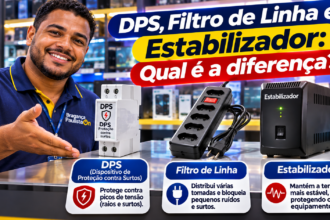
Não, uma régua de tomadas não consegue manter seus aparelhos funcionando quando a energia da rede elétrica acaba. Ela adiciona tomadas, enquanto um protetor contra surtos limita alguns picos de tensão; nenhum dos dois fornece energia contínua durante uma queda de energia.
Uma queda repentina de energia pode interromper o trabalho, parar uma geladeira ou deixar um computador sem tempo para salvar um arquivo. Se você se preocupa em proteger seus equipamentos eletrônicos em casa ou no trabalho, o dispositivo ideal depende do problema: uma queda de energia, um pico de tensão ou simplesmente a falta de tomadas. Aqui estão as diferenças práticas e as verificações que podem te ajudar na escolha.

Principais conclusões
- Uma régua de tomadas adiciona saídas, mas não fornece bateria de reserva.
- A surge protector is designed to limit certain voltage spikes.
- Um sistema UPS (Sistema de Alimentação Ininterrupta) alterna para a energia da bateria quando detecta uma queda na tensão de entrada.
- Verifique o rótulo do produto para confirmar suas características e classificações.
- Escolha o dispositivo adequado ao equipamento e ao problema que precisa resolver.
Para proteção durante uma queda de energia, procure um UPS com bateria de reserva em vez de um extensor de tomadas.
Filtro de Linha Queda de Energia: Saiba o que cada dispositivo pode fazer
A função básica de uma régua de tomadas é adicionar tomadas, enquanto a proteção contra surtos é um recurso separado. Mais tomadas permitem conectar vários aparelhos a um único ponto de energia, mas a quantidade de tomadas não indica qual proteção elétrica o dispositivo oferece.
As características listadas de um dispositivo com múltiplas tomadas, e não seu formato, indicam se ele oferece proteção contra picos de tensão.
Os nomes e as embalagens dos produtos podem ser semelhantes, portanto, leia as especificações em vez de presumir que todas as tiras têm a mesma função.
Uma régua de tomadas adiciona saídas; ela não fornece automaticamente proteção contra surtos.
A power strip adds outlets, not spike protection
A basic power strip lets you connect multiple appliances to one wall outlet. It can help when a desk has more plugs than wall sockets, but it does not protect connected devices from voltage spikes.
Some product listings use terms such as “filtro linha” or “filtros linha.” Those words alone do not establish a device’s features. Look for specific protection ratings and details in the product specifications.
A surge protector adds protection against voltage spikes
A surge protector is designed to limit voltage spikes that could reach connected electronics. The “filtro linha protege” wording on a listing is not enough to confirm that feature; check whether the product is identified as a surge protector and includes surge-protection specifications.
That distinction matters when you compare filters, outlet counts, and protection against electrical events. A surge protector still does not keep equipment running when utility power stops. Check the product label for surge-protection specifications before relying on a multi-outlet device.
What Happens to Electronics During a Voltage Sag?
A brief drop in voltage can be enough to make a computer behave unpredictably or shut down. Voltage sag means a short-term drop in RMS voltage, usually between 10% and 90% of nominal voltage.
A voltage sag can interrupt sensitive equipment, including computers, and cause unsaved work to disappear. A computer may freeze, restart, or shut off before you can save an open document. In some cases, the interruption can also corrupt files or disrupt other devices connected to the electrical network.
Electrical disturbances can occur for several reasons. Common causes include:
- Faults or short circuits on the network.
- Utility interruptions or maintenance work.
- Changes in electrical loads as equipment switches on or off.
These events affect the supply of energy and can briefly change the voltage reaching equipment. A disturbance on the grid may be noticeable across several devices, while a change in a building’s electrical load can affect nearby equipment.
For everyday use, save important work often and enable automatic file saving when your software offers it. Surge protection alone does not prevent data loss from a sag or interruption.
How Surge Protectors Handle Voltage Spikes
A voltage spike can last only a few milliseconds, yet still threaten connected electronics. A surge is a transient wave of voltage or current that usually lasts less than a few milliseconds.
Many surge protectors use metal oxide varistors, or MOVs, to absorb excess energy during a spike and divert it to ground. An MOV responds when voltage rises above its normal range, helping limit the excess that reaches connected equipment. This protection has limits, and the parts inside the device can wear with use.
MOVs divert excess energy
An MOV changes its electrical behavior when it encounters a higher voltage. It provides a path for excess energy to move toward ground instead of passing through to the equipment. The details depend on the protector’s design and ratings, so not every model provides the same level of protection.
This is why an ordinary outlet expander and a surge protector do different jobs. A surge protector is built for certain brief electrical events, while a power strip simply provides more connection points.
Lightning and switching can create surges
Lightning can create a surge on a network, and short circuits can also cause one. Surges may start inside a building when electrical equipment switches on or off.
Examples include variable-speed drives, contactors, and capacitors switching. Those events can produce picos, or brief voltage peaks, in the rede elétrica. In Portuguese, a surge may also be called a surto elétrico; the label does not change the device’s limits.
A surge protector can reduce the risk from some surtos, but it cannot stop every possible event or guarantee that equipment will never be damaged. A surge protector limits certain voltage spikes, but it does not make a home immune to every electrical event.
What to Check Before Buying and Plugging In
A useful first check is whether the product is marked UL 1449. That marking indicates that the surge protector meets safety standards for surge protection.
Read the device’s rating and instructions before connecting equipment. A rating helps describe how the protector performed under a test; it does not promise that every surge will be blocked or that every connected device will be safe.

Read the UL 1449 label and rating
Use the label to distinguish a surge protector from a basic outlet strip. These figures identify specific safety and test details, not the number of appliances the unit can safely power.
| Check | Value or marking | What it tells you |
|---|---|---|
| Safety standard | UL 1449 | Meets safety standards for surge protection |
| Let-through rating | 330 volts | Listed let-through voltage rating |
| Test waveform | 6 kV/3 kA | Waveform associated with the 330-volt rating |
The UL 1449 test waveform associated with a 330-volt let-through rating is 6 kV/3 kA. A joule rating describes a different specification, so do not treat the two ratings as interchangeable.
Check protection status and connect it safely
MOV components can degrade over time, especially after absorbing multiple surges. Some protectors have an indicator light that shows whether surge protection remains active.
Use this short safety checklist:
- Inspect the protection indicator for an active status.
- Replace the unit every three to five years or after a power surge.
- Plug it directly into a wall outlet, not another strip or surge protector.
Daisy-chaining devices can raise the risk of overloading a circuit. A product can still power its outlets after its protective parts no longer work. Replace the protector if its indicator shows protection is inactive, even if its outlets still work.
Can a UPS Keep Your Devices Running During an Outage?
A UPS is the right type of device when your priority is keeping selected equipment powered through an outage. When input voltage drops, a UPS switches to battery power to maintain a supply for connected devices.
A consumer UPS typically provides several minutes to tens of minutes of backup, depending on its battery capacity and connected load. That time may let a computer or server continue operating briefly or shut down safely. A UPS is not a promise of hours of backup for every setup.
Match backup capacity to the devices
Choose what needs to stay powered, then compare the combined load with the UPS capacity. The battery’s runtime falls as the connected load increases, so include all equipment that will draw power during an outage.
Plan around these three checks:
- Identify the devices that need backup.
- Check their combined load against the UPS capacity.
- Decide how long the devices need to remain powered.
A computer or server may need enough time to save work or shut down cleanly. Printers and other high-demand devices may draw enough power to require careful capacity checks before you connect them.
Maintain the battery-backed unit
Battery condition affects how well a UPS performs when the supply fails. Inspections are commonly recommended every 6-12 months, with the schedule adjusted for use and operating conditions.
Read the manual for the unit’s alarms, test steps, and service guidance. A battery can lose capacity over time, which may shorten the period available for a safe shutdown. Test the UPS periodically and follow its manual for battery service and replacement.
Surge Protector Features Across Eight Models
The models differ in outlet count, joule rating, and the connections they provide. These are specification examples, not ranked picks or endorsements.
Compare the listed features with your equipment instead of treating a higher joule rating as proof of universal protection. The figures below describe the named models and listings.

| Model | Joule rating | Outlets | Other stated features |
|---|---|---|---|
| APC Performance SurgeArrest P11VNT3 | 3,020 joules | 11 | Six widely spaced, five standard; telephone, coaxial, Ethernet protection |
| Anker 351 Power Strip | 2,100 joules | 12 | Two USB-A ports; one 20 W USB-C port |
| ECHOGEAR ShockBlocker | 3,420 joules | 8 | Eight outlets |
| Amazon Basics six-outlet surge protector | 790 joules | 6 | Circuit breaker; LED indicator |
| Belkin 12-Outlet Pivot-Plug | 4,320 joules | 12 | Eight outlets pivot |
TechGearLab’s testing lists the Bototek 10-outlet surge protector at 2,100 joules, with four USB ports. A separate Belkin 12-outlet surge protector listing describes 3,780 joules of protection.
The Eaton Tripp Lite TLP606B has six outlets and 900 joules of surge protection. Check that each model’s connections suit your devices, including any plugs that need extra space.
Joule ratings and port counts are specifications, not proof that one model protects every device or is a better choice. Compare a product’s listed protection and outlet features with the devices you actually plan to connect.
What the NEC Requires for Residential Surge Protection
The applicable electrical code depends on the NEC edition adopted by the state and local jurisdiction. The 2023 NEC requires Type 1 or Type 2 surge-protective devices for services supplying dwelling units and several other listed spaces.
Covered devices must have a nominal discharge current rating of at least 10 kA. The requirement also covers dormitory units, hotel and motel guest rooms and suites, and patient sleeping rooms in nursing homes and limited-care facilities.
A required device may be placed at each next level of distribution equipment downstream toward the load, rather than at the service equipment. The 2020 NEC requires a surge-protective device for services supplying dwelling units, including when residential service equipment is replaced.
Code-required surge protection depends on the NEC edition adopted locally, and covered devices must meet the applicable rating.
As of February 1, 2023, 25 states used the 2020 NEC, 17 used the 2017 edition, two used the 2014 edition, and two used the 2008 edition. Those figures show why a national code edition may not match local rules.
Before planning code-required installation, check with the local authority having jurisdiction or a licensed electrician. Confirm the locally adopted code and installation requirements with a licensed electrician or the authority having jurisdiction.
Conclusion
Choose electrical protection based on the problem you need to solve, not on how many outlets a device has. A power strip adds outlets, a surge protector limits certain voltage spikes, and a UPS supplies battery power during an outage.
First decide whether you need more outlets, protection from spikes, or continued operation during an outage. Then check the label on the device you already own and replace it if its protection status is no longer active.
FAQ
Does a surge protector stop a computer from shutting down during a blackout?
No, a surge protector does not stop a computer from shutting down during a blackout because it has no battery backup. A UPS switches to battery power when input voltage drops, which can give a computer time to keep working or shut down safely. How long it runs depends on the battery capacity and the connected load.
How often should I replace a surge protector?
Replace a surge protector every three to five years or after a power surge, and sooner if its protection indicator shows protection is inactive. Its outlets may still work after the protective components have degraded. Check the indicator and the product instructions, since a working light or outlet does not guarantee protection beyond the device’s service life.
What does a 330-volt let-through rating mean on a surge protector?
A 330-volt let-through rating is a UL 1449 surge-protection rating associated with a 6 kV/3 kA test waveform. It describes a tested voltage level, not how long a UPS can run or how many joules a protector can absorb. Joule ratings measure a separate specification, so the two numbers should not be treated as equivalent.
Can I plug one surge protector into another?
No, plug a surge protector directly into a wall outlet rather than into another surge protector or power strip. Connecting devices in a chain can increase the risk of overloading a circuit. If you need more outlets, choose a device with enough outlets for the intended load, and follow its instructions and the circuit’s limits.
Does a surge protector need a grounded outlet to work properly?
Yes, an effective path to ground is important for a surge protector’s line-to-ground protection to divert excess surge energy. A missing or faulty ground can limit that protection, even when the indicator appears normal. If you are unsure whether an outlet is grounded or its wiring is in good condition, have it assessed by a qualified electrician.
What should I connect to a UPS instead of a regular power strip?
Connect equipment that needs temporary battery power, such as a computer or server, to a UPS. The UPS switches to battery power when it detects a drop in input voltage, allowing the device to keep running briefly or shut down safely. Backup runtime depends on battery capacity and the connected load, so check that the unit can support the devices together.